Trauma-informed by design
Sessions are paced to the nervous system, not to a bell. Sensory load is controlled. Demands are gradual.
Alternative Provision · Key Stage 3 & 4 · Suffolk
Suffolk Sensory Kitchen is a trauma-informed Alternative Provision for young people whose attendance has collapsed under Emotionally Based School Avoidance, autistic burnout, anxiety or sensory overload. Across 6 to 12 weeks, our Resilience and Reset programmes use the rhythm of cooking - chopping, stirring, tasting, washing up - to bring a nervous system back online and gently rebuild the habits of being a student.
Our mission
For a rising number of teenagers in Suffolk, the mainstream classroom is no longer a place a body can be in. The reasons are complex - late-identified autism, ADHD, attachment trauma, the after-shock of the pandemic, the cost-of-living crisis, social media saturation, undiagnosed sensory profiles. The result is the same: a child who used to come to school, and no longer can.
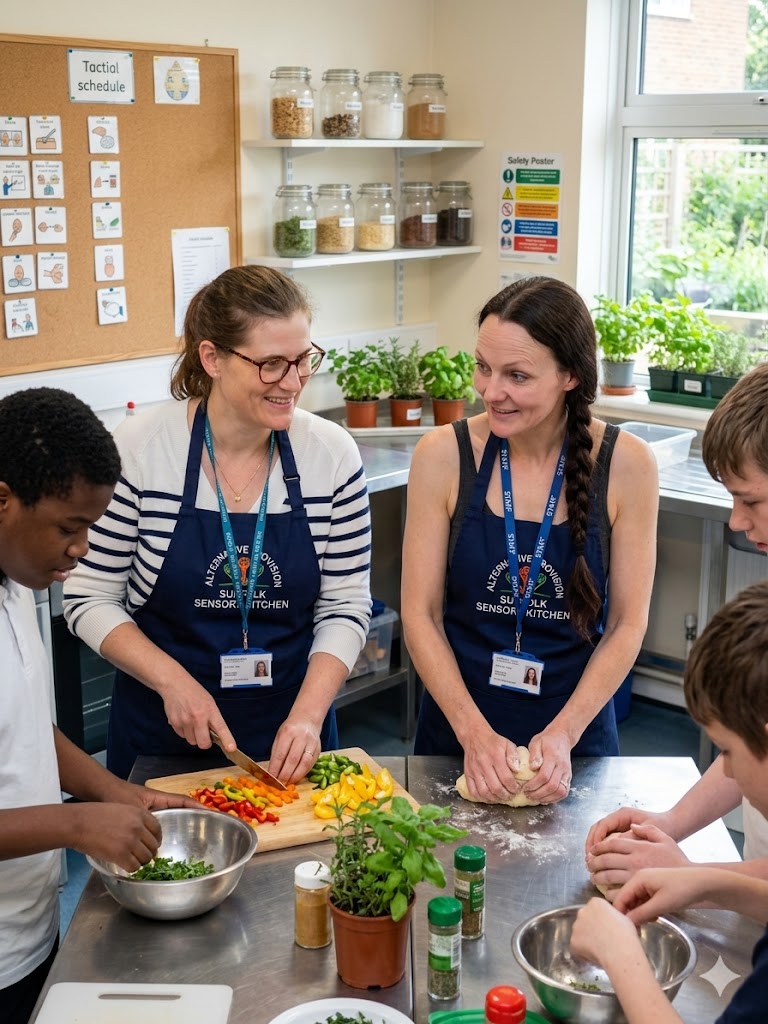
We exist to give that child somewhere else to go. Not a holding pen. Not a soft option. A specialist kitchen-based provision, run by two qualified mainstream teachers, where the curriculum is real, the food is real, and the regulation comes first.
Our model is built on a single observation, repeated thousands of times across our combined careers: learning lands when bodies are fed, calm and useful. Everything we do flows from that.
Why now
National and regional data show why a specialist culinary AP is no longer a nice-to-have. The figures below are drawn from publicly available sources and should be re-verified at every quarterly board review.
1 in 5
children and young people aged 8–25 in England likely to have a probable mental disorder, NHS Digital Mental Health of Children and Young People surveys (latest available).
150,256
severely absent pupils (attendance below 50%) recorded in England in the most recent DfE statistical release on absence.
1 in 8
adolescents in England estimated to be living in a household experiencing food insecurity (Food Standards Agency, Food and You 2 surveys).
60%
of an average UK adolescent diet is now ultra-processed (UK national diet surveys; varies by survey wave).
Figures retained here as a directional summary. Specific commissioning bids will quote against the latest published release for the relevant academic year.
The programme
Phase 1 · Weeks 1–3
The young person is welcomed into a small, calm kitchen with no academic demands on day one. We map their sensory profile, their food world (likes, aversions, fears), their routines and their relationships. We co-write a one-page profile. We bake bread.
Phase 2 · Weeks 4–8
The four-module Modern Home Economics curriculum begins. Students plan, shop, cook and eat real meals as a group. Stealth maths, literacy, science and PSHE are woven through every session. Confidence in the body returns first; confidence in the mind follows.
Phase 3 · Weeks 9–12
With the home school, the family and (where applicable) the local authority, we co-author a clear next step: phased return to mainstream, a managed move, KS4 vocational pathway, or extension into a longer placement.
Who we help
We are commissioned by SENCOs and inclusion leads when the timetable, the building and the social demands of mainstream have simply outrun what the child’s nervous system can do.
We are deliberately a small provision. We are not, and will not pretend to be, the right setting for every young person. Our SLA is clear on the indicators that trigger an honest, early conversation with the commissioner.
Founders
Kirsty Wilson and Selina Finch each spent over a decade leading mainstream secondary Food Technology classrooms. They watched their most vulnerable and neurodivergent students slowly disappear from the registers - not because they couldn’t cook, but because the building, the timetable and the social load had become unbearable. They built Suffolk Sensory Kitchen as the place those young people should have had all along.
Read the founders’ story →For commissioners
Request a referral pack, view our SLA and pricing tiers, and start a dual-registration conversation.
Open the referral form →For SENCOs & parents
Walk through Modern Home Economics - UPF Trap, Gut-Brain Axis, Micro-Budgeting and Digital Detox.
See the four modules →